
Students taking the SAT for the first time can feel overwhelmed when they reach the second module of the Reading and Writing or Math sections. They can seem ridiculously difficult, especially when compared with the PSAT or even the official Bluebook practice tests.
01Why is the second module harder at all?
Both the PSAT and the SAT are section-adaptive tests, and each section is broken into two modules. That is, the test takes into account how well you did on the first module and decides whether you should take a second module that is easier, with more straightforward problems or a second module that is harder, with problems that can sometimes seem like they might as well be written in a language you don't understand. While you won't know exactly which difficulty module you're getting at test time, it's actually a good sign that you've been given a harder module - it means that you did well on the first module, and you're on your way to a higher score.
If you're assigned the easier module, everything probably seems okay: you're getting problems at an appropriate difficulty level, and there aren't sudden spikes in how hard the test seems to you. If you're assigned the more difficult module, you're likely to run across problems that are really, really challenging, even compared to hard problems you might have encountered on the PSAT. Why?
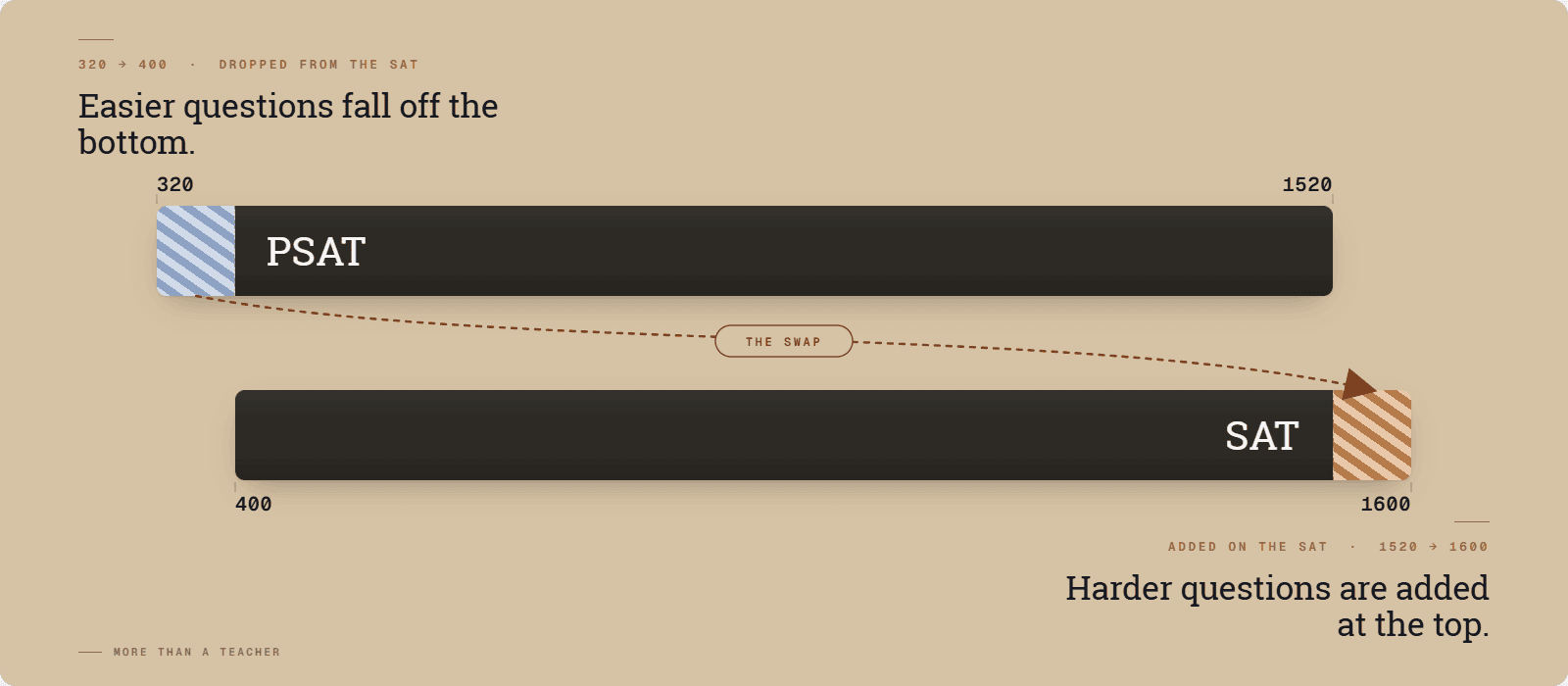
It all has to do with how the test is scored and what the College Board - folks who make the test - is trying to accomplish. The PSAT is, primarily, a diagnostic and practice test. (Well, and a way for the College Board to make money, too.) It gets used to determine National Merit cutoffs, but colleges don't accept a PSAT score in lieu of an SAT score, so there's no need to have the same degree of differentiation as the SAT. The PSAT is also scored differently, from a 320 to a 1520, instead of the SAT's more familiar 400-1600.
On the actual SAT, though, things are different. First, the College Board tries to make its tests' scores align. Its track record at this is spotty, at best, but its goal is to make the SAT 80 points harder than the PSAT, so that scores on both tests line up, even though they don't have the same range. To do that, the SAT needs to drop 80 points of easy questions on the bottom end and add 80 points of questions at the top end.
The other thing the College Board is trying to accomplish is to spread out students who score at the very top of the scale. While it's not relevant to most colleges, extremely selective schools do care about the difference between a 1450 and a 1550, and if all those students are getting all the questions right, it's impossible to split out their scores. To resolve this, the SAT needs a significant number of very difficult questions - questions that only the very top test-takers will get right consistently.
Taken together, this means that not only does the SAT need more hard questions, but those questions themselves need to be more difficult. What about the content on the Bluebook practice tests? They're the closest thing out there to the actual SAT, but the College Board isn't strongly incentivized to put its best/most difficult material out there - it's saving it for the actual test.

02So why shouldn't I worry about these hard problems?
It can be very discouraging to feel good about the first module on the test, start up the second, and then quickly feel like you don't know how to do any of the problems. Most students incorrectly assume that this means they're going to do terribly on the test - there were so many questions they didn't know how to do! There's probably no need to worry, though. Unless your score is already at a 1350 or above, the SAT isn't expecting you to get any of its ridiculously-hard-tier questions right. Your score will come out fine - just focus on the problems that you can do, and don't waste time on the questions that are too difficult (but don't leave them blank!)
If you're already a high-scoring student looking to improve, the best source for the SAT's hardest questions is the College Board's own test bank. There are actually two: the Student Question Bank (requires a College Board sign-in) and the Educator Question Bank. Pull up the section that you're having trouble with, then filter to show only hard questions. Need tips? Get in touch with us.


